
TheStoryofAishBalady(العيشالبلدي):History,Health,andEgypt'sMostImportantBread

🌾 What Is Aish Balady? The Name Tells the Story
The Arabic word عيش (ʿaysh) doesn't just mean "bread" — it means life. When Egyptians say Aish Balady (العيش البلدي), they are literally saying "the life of the land" or "the folk bread." No other food name in Arabic carries this weight. Bread isn't a side dish in Egypt — it is the meal, the currency, the culture, the prayer. To understand Aish Balady is to understand Egypt itself.
This round, slightly domed flatbread, made from whole-wheat flour and baked in screaming-hot clay ovens, puffs up dramatically in the oven, forming a pocket that is torn open for dipping, stuffing with foul (fava beans), ta'meya (falafel), or gebna beyda (white cheese). At roughly 5 Egyptian pounds (less than a cent at market rates), it remains the most subsidized, most consumed, and most emotionally significant food in one of the oldest civilizations on Earth.
🏺 5,000 Years of Egyptian Bread
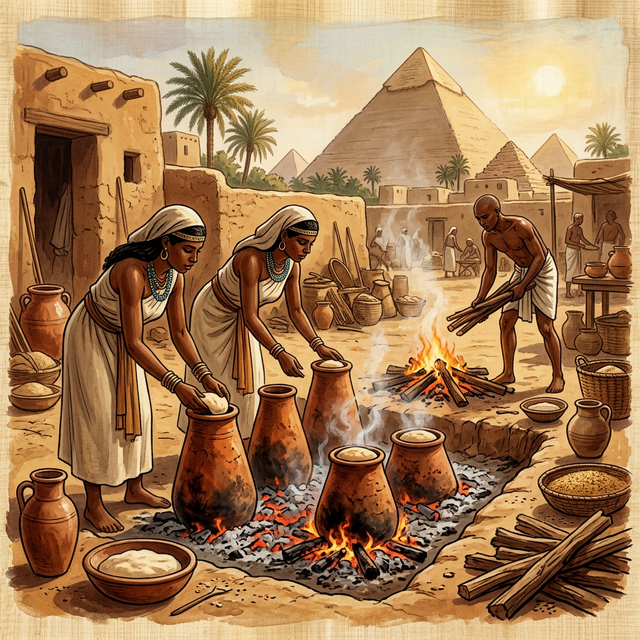
Egypt is arguably the birthplace of leavened bread. Archaeological evidence from ancient sites at Deir el-Medina, the workers' village near Luxor, reveals clay bread molds, sieves, and storage jars dating to over 3,000 BCE. Tomb paintings — particularly from the 19th Dynasty (circa 1290 BCE) — depict bakers kneading dough with their feet, shaping loaves, and loading them into conical clay ovens called tabun.
The ancient Egyptians understood fermentation empirically long before microbiology existed. They maintained sourdough starters — colonies of wild yeast and lactic acid bacteria — that were passed from generation to generation. Samples of ancient Egyptian bread found in tomb offerings have been analyzed and found to contain the same genus of wild yeast (Saccharomyces cerevisiae) still used in Egyptian bakeries today. This is possibly the longest continuous food tradition in human history.
Herodotus, the Greek historian who visited Egypt around 450 BCE, was famously scandalized by Egyptian bakers kneading dough with their feet — a practice that maximized surface contact and, they believed, improved gluten development. He noted that bread was traded, used as payment for labor, and was so culturally central that the Egyptian word for "to eat" was synonymous with "to eat bread."
🔹 From Pharaonic Tabun to Modern Afran
The clay tabun oven of the Pharaohs evolved into the furn (furnace) of the Islamic period and then into the modern afran balady (folk bakeries) — a network of government-subsidized neighborhood ovens that produce millions of loaves daily. The technology changed: from clay pots over open fire to ceramic-tiled rotary ovens that can bake 10,000 loaves per hour. But the bread remained strikingly similar: round, whole-wheat, slightly pocketed, slightly smoky, and earthy.
🌿 What Makes Aish Balady Different from Pita
Many Westerners mistakenly call Aish Balady "pita bread," but this comparison frustrates any Egyptian baker. The differences are significant:
- Flour: Aish Balady uses whole-wheat flour (80-90% extraction or higher), giving it its characteristic earthy, slightly bitter, nutty flavor and darker beige-brown color. Pita is made from white refined flour, producing a lighter, blander result.
- Leaven: Traditional Aish Balady is leavened with natural sourdough starter (locally called khamira balady). Commercially produced versions may use commercial yeast, but the flavor profile loses significant depth.
- Hydration: The dough for Aish Balady is substantially wetter — closer to 75-80% hydration — than typical pita dough. This produces a more irregular, open crumb with better pocketing.
- Baking temperature: Authentic Aish Balady is baked at extremely high temperatures (280–320°C), producing rapid steam generation inside the dough that forces the characteristic full pocket formation with a slightly charred exterior.
- Bran content: The high bran content from whole wheat gives the bread its characteristic texture — slightly chewy, with a seeded, grainy exterior finish from the bran particles.
🔬 The Science of the Pocket: How It Forms
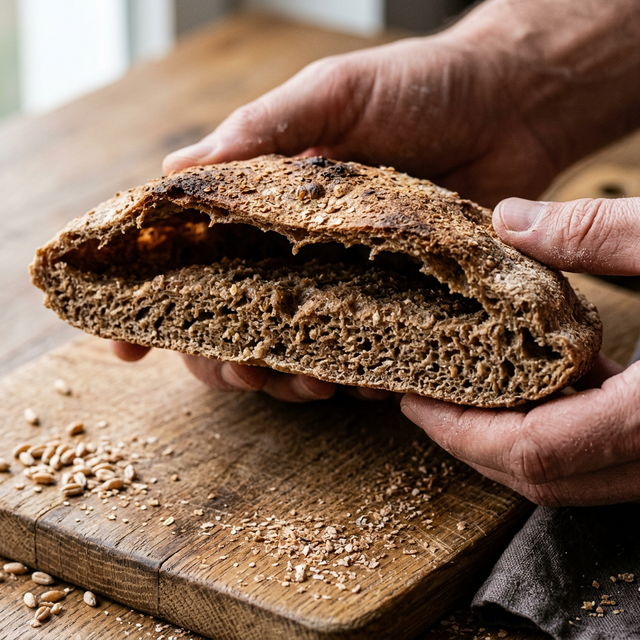
Aish Balady's signature pocket is a study in applied thermodynamics and food science. When the thin, flat disc of dough hits the intensely hot oven floor, the bottom surface instantly gelatinizes — forming a rigid crust. Meanwhile, the CO₂ and water vapor trapped within the still-wet interior of the dough has nowhere to go but up, pushing the soft upper layer of gluten upward in a uniform dome. In 60–90 seconds, the bread has fully puffed, and in the dry heat, this pocket stabilizes.
The key variables that determine pocket quality:
- Oven temperature: Below 250°C, the steam escapes gradually rather than forming a dramatic pocket. At 300°C+, the pocket forms rapidly and fully.
- Dough uniformity: If the dough is rolled unevenly, the pocket forms asymmetrically. Experienced bakers achieve consistent thickness through practiced hand-rolling.
- Gluten development: Properly developed gluten creates a membrane strong enough to hold the pocket without tearing. Under-kneaded dough produces flat bread; over-kneaded produces dense bread.
- Hydration level: Higher hydration = more steam = bigger pocket. The whole-wheat flour in Balady dough absorbs substantially more water than white flour, enabling this higher hydration.
💚 Nutritional Profile: Why Whole Wheat Matters
From a nutritional standpoint, Aish Balady's use of whole-wheat flour gives it a significant advantage over refined white bread or commercial white pita:
- Fiber: A single 100g Aish Balady contains approximately 6-7g of dietary fiber — compared to 2-3g in white pita. The bran layer, retained in the whole-wheat flour, slows glucose absorption and supports digestive health.
- Micronutrients: Whole wheat retains the germ layer, which is rich in Vitamin E, B vitamins (thiamine, niacin, B6, folate), iron, magnesium, zinc, and manganese — all of which are stripped out in refined flour production.
- Glycaemic Index: The glycaemic index of whole-wheat sourdough Aish Balady is estimated at 40-50, compared to 70-75 for white pita and 85-95 for white baguette. The organic acids produced during sourdough fermentation reduce starch digestibility, resulting in a flatter blood sugar response.
- Antioxidants: Wheat bran contains phenolic acids and flavonoids — compounds with anti-inflammatory properties that are absent in refined flour products.
- Protein: Despite common assumptions, whole-wheat bread provides approximately 8-9g of protein per 100g — not trivial for populations where it forms a primary caloric staple.
For Egypt's lower-income population, where Aish Balady may represent 40-60% of daily caloric intake, its nutritional density is quite literally a matter of public health significance. The Egyptian government's bread subsidization program (تموين, Tamween) has maintained this nutrition buffer for over 60 years.
🏙️ The Afran Balady: Egypt's Neighborhood Oven Network
In every Egyptian neighborhood — from the narrow lanes of Old Cairo to the new desert cities of New Cairo and 6th October City — the furn balady (neighborhood bakery) is a community institution. At dawn, even before the fajr call to prayer fades, the ovens are lit. By 6 AM, queues form. By 10 AM, 10,000+ loaves have been produced from a single oven.
The subsidized price — maintained at 5 piastres per loaf since the 1980s (though recently adjusted upward amid economic pressures) — means that the average Egyptian family spends a fraction of their income on what would be, in any other country, an artisanal whole-wheat sourdough product sold for $5+ a loaf in specialty bakeries.
This creates a fascinating inversion: Egypt's poor eat fermented whole-grain bread daily as an economic necessity, while urban professionals in New York, London, and Tokyo pay a premium for the same nutritional experience marketed as health food and artisanal craft.
👩🍳 How to Bake Authentic Aish Balady at Home
Replicating Aish Balady outside Egypt is challenging but achievable. The primary obstacle is oven temperature: domestic ovens rarely exceed 250°C, while professional bakeries operate at 300°C+. Here's the best approximation:
🔹 The Starter (Khamira Balady)
If you have access to a sourdough starter, use it. If not, combine equal weights of whole-wheat flour and water (100g each) in a jar. Leave at room temperature, feeding daily with 50g flour + 50g water. After 5-7 days, active bubbles indicate fermentation. Your personalized Egyptian khamira is ready.
🔹 The Dough
- 400g whole-wheat flour (high-extraction / stoneground preferred)
- 100g bread flour (for better gluten structure)
- 375ml warm water (75% hydration)
- 100g active sourdough starter (or 7g instant yeast)
- 10g salt
- Optional: 1 tsp nigella seeds (حبة البركة) worked into the dough — traditional in some Egyptian regions
Mix all ingredients until incorporated. Perform stretch-and-fold every 30 minutes for 3 hours at room temperature (bulk fermentation). Shape into balls of 80-100g, rest 30 minutes, then roll flat to 20cm diameter, 4-5mm thick.
🔹 Baking at Home
Place a baking steel or large cast-iron pan on the oven's highest rack and preheat at maximum temperature (250°C / 480°F) for at least 45 minutes. Slide the dough directly onto the steel. Bake for 2-3 minutes. The bread should puff fully. Remove and wrap in a clean cloth (this traps steam and keeps the pocket from collapsing). Serve immediately — Aish Balady is always at its best fresh from the oven.
✨ Aish Balady in Egyptian Culture and Identity
Bread in Egypt carries an almost sacred significance. The word for "bread" (عيش) is the same as the word for "life." Throwing bread in the trash is considered sinful. During difficult economic periods, bread queues have triggered riots — the 1977 Egyptian Bread Riots, sparked by IMF-mandated removal of subsidies, resulted in 79 deaths and forced President Sadat to restore the subsidies within 48 hours.
In weddings, bread is broken as symbol of unity. In funerals, bread is distributed as charity (sadaqa). Children are taught from birth that wasted bread is a sin. In Ramadan, iftar tables across Egypt would feel incomplete — unimaginably wrong — without a stack of freshly baked Aish Balady at the center.
The great Egyptian poet Ahmed Fouad Negm wrote about bread as the measure of justice: "The people who don't have bread to eat, how will they survive?" — words that remain as resonant today as when he wrote them in the 1970s.
🔹 Conclusion: A Living Museum of Bread-Making
Every morning, when an Egyptian baker slides a wooden paddle under a perfectly round disc of whole-wheat dough and loads it into a 300°C oven, they are performing an act that is 5,000 years old in its essence. The bacteria in the sourdough starter are the cultural descendants of strains discovered by accident in ancient grain stores. The pocket formed in the oven obeys the same thermodynamics that surprised Pharaonic bakers who discovered leavening.
Aish Balady is not a commodity. It is a living museum — distributed across tens of thousands of neighborhood ovens, reproduced millions of times daily, tasted fresh every morning by 100 million Egyptians. And in that daily act of tearing open a warm, steaming loaf, the oldest civilization on Earth continues to practice its most ancient and most democratic art.
عيش وملح — "bread and salt" — the Egyptian phrase for the bond between people who share a meal. May it never be broken.
Motaz Hefny
Founder of MotekLab | Senior Identity & Security Engineer
Motaz is a Senior Engineer specializing in Identity, Authentication, and Cloud Security for the enterprise tech industry. As the Founder of MotekLab, he bridges human intelligence with AI, building privacy-first tools like Fahhim to empower creators worldwide.
Discussions (0)
Join the Conversation
Sign in with your Google account to share your insights with the community.